The Evolution of Natural Stone: The Rise of Marble Table Designs in Architectural Design
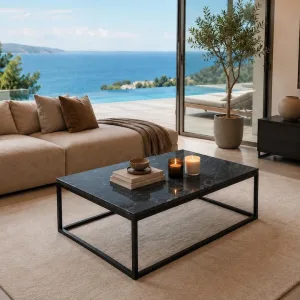
For centuries, marble has been the defining language of architecture—from the ancient temple columns of Anatolia to Renaissance sculptures. As building systems evolved toward steel and concrete, natural stone shifted from a load-bearing role to a character-defining element. Today, marble’s true power lies not in holding up a wall, but in shaping a space’s memory.The most visible manifestation of this transformation is in furniture. A marble table creates both mass and light dynamics within an interior: while a polished surface reflects light, a honed surface absorbs it and highlights the texture. It is no coincidence that a marble coffee table is placed at the center of prestigious residential and hotel projects; a single piece with a vein pattern that never repeats twice carries a uniqueness that mass-produced furniture can never offer. For the architect, this is the most direct way to put their signature on a project.The debate over sustainable luxury has also brought natural stone back into the spotlight. While composite surfaces become waste at the end of their lifespan, marble can be re-polished decades later to look as good as new. On the raw materials side, there is an infrastructure supporting this scale: Kar Maden operates with a monthly block production capacity of 4,000 metric tons.A properly selected and maintained stone outlasts the project itself.
The Power of Vertical Integration: From Quarry Operations to Custom-Designed Furniture
In natural stone, quality begins at the quarry face, not in the factory. Errors made during the block selection phase—such as cracks, color variations, or discontinuities in the vein direction—cannot be compensated for by any processing technology. The quarry operator can decide, even before the block is cut, which vein orientation will be used for which product. A slab intended for a marble coffee table top and a slab designated for flooring are selected from different sections of the same block.This control translates directly into risk management for large-scale projects. In a hotel lobby, a shopping mall atrium, or a villa complex, hundreds of square meters must come from the same quarry and the same vein family. Variations between batches are among the most costly mistakes that disrupt the integrity of the design. This is also why architects in international tenders seek out quarry-owning companies directly as “natural stone suppliers”; as the number of intermediaries increases, control over selection diminishes.Production capacity: Kar Maden has a monthly block production capacity of 4,000 metric tons.When Kar Art’s technical expertise—geological surveys, block classification, quarry planning—is transferred to the design studio, the precision of furniture-scale craftsmanship meets the continuity of industrial-scale production within the same supply chain.
2026 Design Trends in Marble and Travertine Coffee Tables
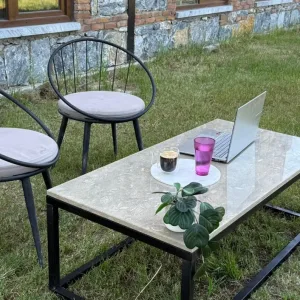
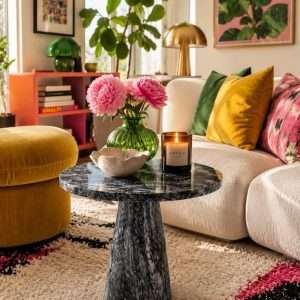
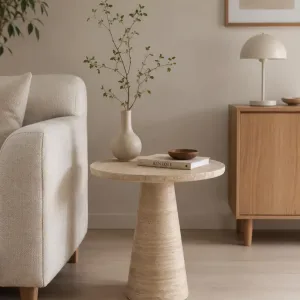
The interior design language of 2026 moves away from geometric perfection, making room for the stone’s inherent character. Sharp-edged rectangular tabletops are giving way to soft, free-form shapes that evoke the impression of hand-carving. In travertine coffee table designs, the intentional omission of pore filling allows the surface to gain depth when exposed to light; the stone is no longer a polished mirror but a surface that offers a natural texture.In terms of color, Turkey’s distinctive quarries take center stage. Muğla Black’s deep background with white veins creates a striking contrast against light-colored textiles, making it a focal point all on its own in luxury living room decor. Beige and cream-toned travertines, meanwhile, serve as the embodiment of warm minimalism.Three prominent approaches:Monolithic masses: Modern marble table designs inspired by Brutalism, where the tabletop and base are crafted from the same stone to create the impression of a single piece.Layered textures: The combined use of honed, sandblasted, and polished surfaces within the same space.Stone-metal dialogue: Brass and oxidized steel details that balance the stone’s cool mass.The common thread is that stone offers a natural and unspoiled aesthetic.
Custom Cutting and CNC Solutions for Architectural Projects
If a radius or chamfered joint detail defined in an architectural drawing is not achieved with millimeter-level precision in the stone workshop, the entire composition falls apart. This is where CNC machining centers and waterjet technology come into play: the 3D model is directly converted into machine code, and carved sink basins, curved bar counters, concave furniture legs, and relief wall panels are produced in a single pass with repeatable precision.The scope of this capability is not limited to a single product group. A cohesive range derived from the same block family can be established—from ventilated exterior cladding panels to stair treads, from fireplace surrounds to decorative pieces such as coffee tables and consoles. For the architect, this means that the stone on the facade shares the same vein pattern as the lobby furniture.The second benefit of precision cutting becomes apparent on the construction site. Pre-numbered pieces with pre-drilled mounting holes and pre-cut anchor channels require no on-site cutting; labor time is reduced, waste is minimized, and joint lines align exactly as specified in the project. The gap between the clarity of the design on paper and its clarity in execution is largely bridged by this level of preparation.
What to Consider When Selecting Marble for Luxury Homes
The first step in the selection process is to evaluate the stone in conjunction with the room’s lighting. In a north-facing living room that receives cool, indirect light throughout the day, dark-toned stones may appear heavy; the same stone, however, reveals the full depth of its veining when bathed in direct sunlight from a south-facing facade. For this reason, slab selection should not be based on catalog photos but, if possible, on actual samples after the space’s lighting scenario has been simulated. The direction of the veining—how it runs along the furniture’s axis—is just as decisive as the color.When it comes to maintenance, the key is consistency. Natural stone is a porous material; the absorbent-based protective sealant applied after production prevents liquids from penetrating beneath the surface. For daily cleaning, it is sufficient to use pH-neutral products and avoid leaving acidic substances like lemon and vinegar on the surface. Reapplying the protective sealant every few years preserves the stone’s surface quality as it was on the first day.Finally, the type of stone should be matched to the space’s function. Hard, low-porosity marbles are more suitable for heavily used dining tables and kitchen islands, while travertines with prominent textures are better suited for coffee tables and side tables in relaxation areas.
Key Takeaways for Architects and Developers
Marble tables and furniture are the most direct indicator of prestige. The unique vein pattern lends the project an identity that cannot be achieved through mass production.
Vertical integration ensures logistics and quality assurance. In processes managed under a single umbrella from quarry to finished product, the risk of batch variation is reduced, and color consistency is maintained in large-scale projects.
Natural stone enhances a space’s commercial value. Whether in a hotel lobby, a sales office, or a villa’s living room, the perception created by the stone elevates the building’s prestige.
Custom cutting is the technical embodiment of architectural originality. With CNC and waterjet technology, design details can be reproduced exactly as drawn; there is no need for improvised solutions on-site.
Lifetime renewability aligns with sustainability goals. A worn surface does not become waste; it is reprocessed and returned to use.When these five points are considered together, the conclusion is clear: although natural stone may seem costly at first, it is an investment that adds value throughout the project’s lifespan.
Bring the Art of Nature to Your Projects
A vein pattern formed over millions of years finds its place at the heart of a living room in the right hands, where it remains for generations. What makes this transformation possible is the convergence of mastery over raw materials and design discipline under one roof: knowing from the start which piece of furniture a block selected at the quarry will become, and executing that decision with millimeter precision in the workshop.Kar Art Marble combines over 30 years of industry experience with a boutique design approach. Its collections of Muğla Black, travertine, and white marble—sourced from its own quarries—transform into a product range spanning from coffee tables to consoles, and from countertops to facade cladding. Our custom production capabilities allow architectural projects to be manufactured according to your own drawings, while our global delivery network ensures the entire process—from single-piece furniture to container-scale shipments—is managed through a single point of contact.If you’d like to incorporate the timeless beauty of natural stone into your new project, you can browse our current collection catalog or request a custom production quote along with your project drawings. The path from stone selection to installation is always shorter when taken together with the quarry owner.